Fixed asset accounting gives finance teams a structured way to record the financial impact of long-term assets from acquisition through disposal. The process includes capitalization, depreciation, adjustments, transfers, reconciliation, reporting, and retirement, all of which affect the accuracy of financial records.
For organizations with significant asset portfolios, those activities can span multiple locations, entities, depreciation treatments, and reporting periods. A consistent accounting process helps Controllers, Tax Managers, CPAs, and other finance professionals maintain reliable asset records while supporting close, tax preparation, forecasting, and audit requirements.
What Is Fixed Asset Accounting?
Fixed asset accounting is the process of recording, depreciating, reconciling, and reporting long-term assets throughout their financial lifecycle. It covers initial recognition, subsequent depreciation and changes, transfers or adjustments, and eventual disposal or retirement.
A qualifying capital expenditure is recorded as an asset rather than treated entirely as a current-period operating expense, with its cost recognized according to the organization’s applicable accounting policies. Accurate fixed asset accounting therefore depends on more than a depreciation calculation. Finance teams need reliable information about cost, dates, classification, depreciation treatment, transactions, accumulated depreciation, and current status so supporting asset records remain aligned with financial reporting.
What Is Considered a Fixed Asset in Accounting?
Fixed assets generally include long-term resources used in business operations rather than held for resale. Common examples include buildings, machinery, production equipment, vehicles, furniture, fixtures, and computer equipment.
For U.S. tax depreciation, IRS Publication 946 explains that depreciable property generally must be owned, used in a business or income-producing activity, have a determinable useful life, and be expected to last more than one year. Land itself is not depreciable. Classification for financial reporting depends on the facts and the organization’s accounting policies.
For a broader discussion of asset definitions and depreciable property, see Bassets’ What Are Fixed Assets? guide.
How Fixed Asset Accounting Works Across the Asset Lifecycle
A sound fixed asset accounting process follows the financial history of an asset rather than treating depreciation as an isolated calculation. Finance teams need to capture the decisions and transactions that change an asset’s recorded value from acquisition through retirement.
1. Identify the asset and determine capitalization
The first step is determining whether an expenditure should be capitalized under the organization’s accounting policy. The decision can involve the nature of the expenditure, expected period of benefit, capitalization thresholds, and applicable reporting requirements. Once capitalized, the organization establishes the asset’s recorded cost or basis.
Construction projects may require separate treatment while costs accumulate before the completed asset is placed in service. Bassets’ Construction in Progress capitalization guide covers that specialized workflow in greater depth.
2. Create the fixed asset record
A complete fixed asset record provides the information needed to calculate depreciation, process later transactions, reconcile balances, and support reporting. Depending on the organization’s requirements, the record may include:
- Asset description and identification number
- Acquisition date and placed-in-service date
- Recorded cost or basis
- Asset class
- Useful life or recovery period
- Depreciation method and convention
- Location, department, or business unit
- Relevant general ledger accounts and supporting transaction information
Dates deserve particular attention. IRS Publication 946 states that property is placed in service when it is ready and available for a specific use. That date determines when U.S. tax depreciation begins.
3. Calculate and record depreciation
Depreciation allocates or recovers the depreciable amount of an asset over the applicable period. The calculation can depend on basis, useful life or recovery period, method, convention, placed-in-service date, and subsequent adjustments.
For U.S. federal tax purposes, MACRS includes the General Depreciation System (GDS) and Alternative Depreciation System (ADS), which can use different methods and recovery periods. Section 179 and special depreciation allowances can also affect tax treatment when applicable. Finance teams should verify current-year rules before relying on an older schedule.
For a focused explanation of depreciation inputs and methods, see Bassets’ What Is Depreciation? resource.
4. Record changes during the asset’s life
Fixed asset records can change throughout an asset’s useful life. Transfers, additions or improvements, adjustments, reclassifications, partial disposals, and full disposals may affect cost, basis, depreciation, location, or reporting. Relevant events should be reflected consistently in the asset record and accounting records so finance can explain how current balances developed.
Readers who need a broader operational view of how documents, processing, fixed asset software, reports, and exports fit together can use Bassets’ fixed asset management process flow.
5. Reconcile fixed asset records with the general ledger
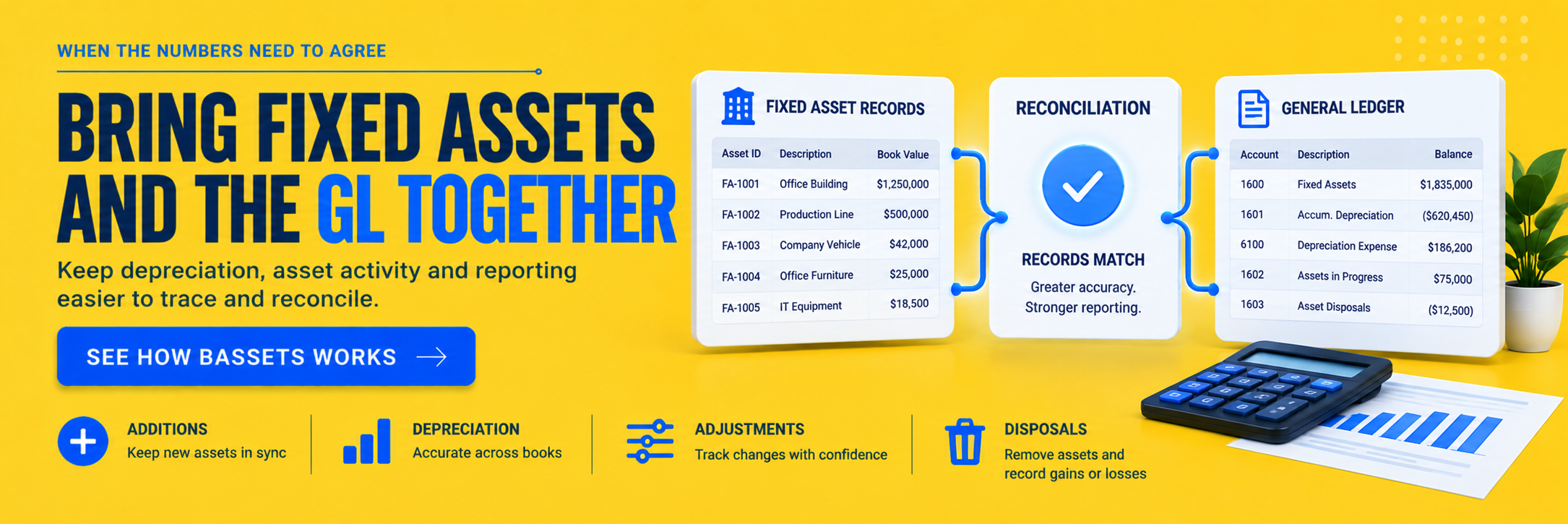
Reconciliation is a core fixed asset accounting control. The detailed asset records and related general ledger balances should tell the same financial story. Depending on the reporting structure, finance may reconcile asset additions and cost, depreciation expense, accumulated depreciation, transfers, adjustments, disposals, and gains or losses on disposal.
Differences should be investigated rather than carried forward without explanation. Regular reconciliation can identify transactions posted to the GL but missing from the asset records, as well as asset activity that has not reached the appropriate GL accounts.
6. Retire or dispose of the asset
When an asset is sold, retired, abandoned, or otherwise removed from service, the accounting record needs to reflect the event. The process may require removing the asset’s recorded cost and associated accumulated depreciation and recognizing any applicable gain or loss. Historical asset and depreciation information should remain available for tax support, audits, and prior-period analysis.
Fixed Asset Accounting Journal Entries: A Simple Example
Journal entries connect the detailed fixed asset record to the general ledger. Consider a simplified example in which a company purchases equipment for $60,000 in cash and capitalizes the full amount.
Recording the asset purchase
The debit records the capitalized equipment cost, while the credit reflects the cash paid.
Recording depreciation
Assume, solely for illustration, that the company’s applicable accounting policy results in $12,000 of depreciation expense for the period.
The equipment remains recorded at historical cost while accumulated depreciation tracks depreciation recognized against it.
Recording a disposal
A disposal entry depends on the asset’s recorded cost, accumulated depreciation at the disposal date, proceeds received, and any resulting gain or loss. Finance therefore needs an accurate asset history before preparing the entry. These examples are simplified; actual entries depend on the transaction, chart of accounts, accounting policies, and applicable reporting requirements.
Book and Tax Treatment of Fixed Assets
Book and tax depreciation can produce different results for the same asset because they serve different reporting purposes and can use different lives, methods, conventions, elections, or deductions. For U.S. federal tax purposes, IRS Publication 946 explains MACRS, Section 179, special depreciation allowances, basis, placed-in-service rules, and related requirements.
Organizations may consequently need multiple depreciation views for one underlying asset. The accounting challenge is maintaining those treatments without losing the connection to the governed asset record. Teams comparing financial-reporting frameworks can use Bassets’ GAAP vs. IFRS for Fixed Assets resource for a more focused standards discussion.
Common Fixed Asset Accounting Challenges
Fixed asset accounting problems often develop when asset activity and accounting records stop moving together. A spreadsheet may contain one cost, the GL another, while a disposal or transfer waits to be recorded elsewhere.
- Inconsistent capitalization decisions across departments or entities
- Missing or incomplete asset records
- Incorrect acquisition or placed-in-service dates
- Depreciation errors caused by incorrect methods, lives, conventions, or basis
- Book and tax schedules that require extensive manual reconciliation
- Transfers or adjustments recorded inconsistently
- Disposed assets remaining in active records
- Fixed asset balances that do not reconcile to the GL
- Weak supporting documentation for asset changes
- Multiple spreadsheet versions with unclear ownership
The financial impact can extend into depreciation expense, accumulated depreciation, tax calculations, close procedures, management reporting, and audit support. Earlier identification gives finance more time to investigate the underlying transaction before reporting deadlines.
Fixed Asset Accounting Best Practices
Strong fixed asset accounting depends on repeatable controls around underlying data and transactions. Finance teams can strengthen the process through several practical disciplines:
- Document the capitalization policy so qualifying expenditures are handled consistently.
- Standardize the information required when each asset is created.
- Record additions, transfers, adjustments, partial disposals, and retirements promptly.
- Maintain the book, federal tax, state tax, and other depreciation treatments the organization requires.
- Reconcile fixed asset records with the general ledger and investigate unexplained differences.
- Preserve documentation supporting material asset changes and transactions.
- Include fixed assets in close, tax, and audit preparation so exceptions surface before they become larger reconciliation issues.
Organizations subject to more formal internal-control requirements may also need authorization, access, change-management, and review controls around fixed asset data. Bassets’ fixed assets and SOX compliance article provides additional context for that control environment.
When Dedicated Fixed Asset Accounting Software Can Help
Spreadsheets can support straightforward asset schedules, but control and review work can increase as organizations maintain multiple depreciation treatments, frequent transfers and disposals, larger asset populations, recurring projections, or substantial reconciliation activity.
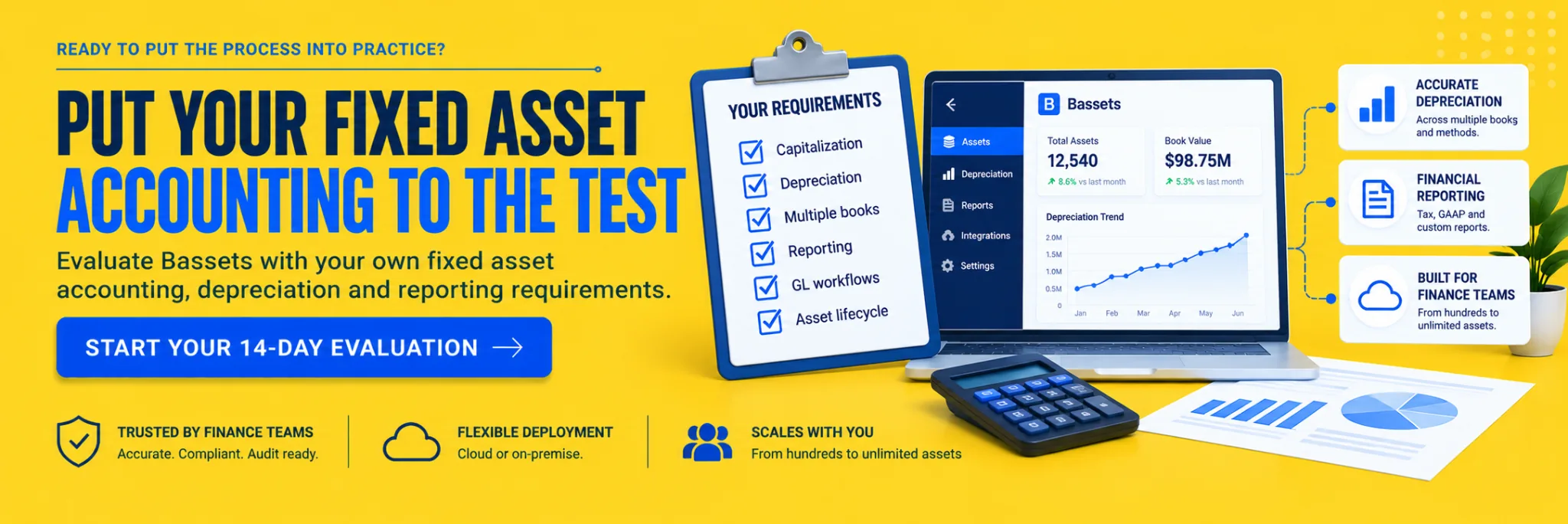
Dedicated fixed asset software can centralize asset records and depreciation calculations while supporting lifecycle transactions, reporting, and GL workflows. Finance teams evaluating that transition can use Bassets’ fixed asset software features guide to build requirements, while teams comparing products can move to the dedicated fixed asset accounting software comparison.
How Bassets Supports Fixed Asset Accounting
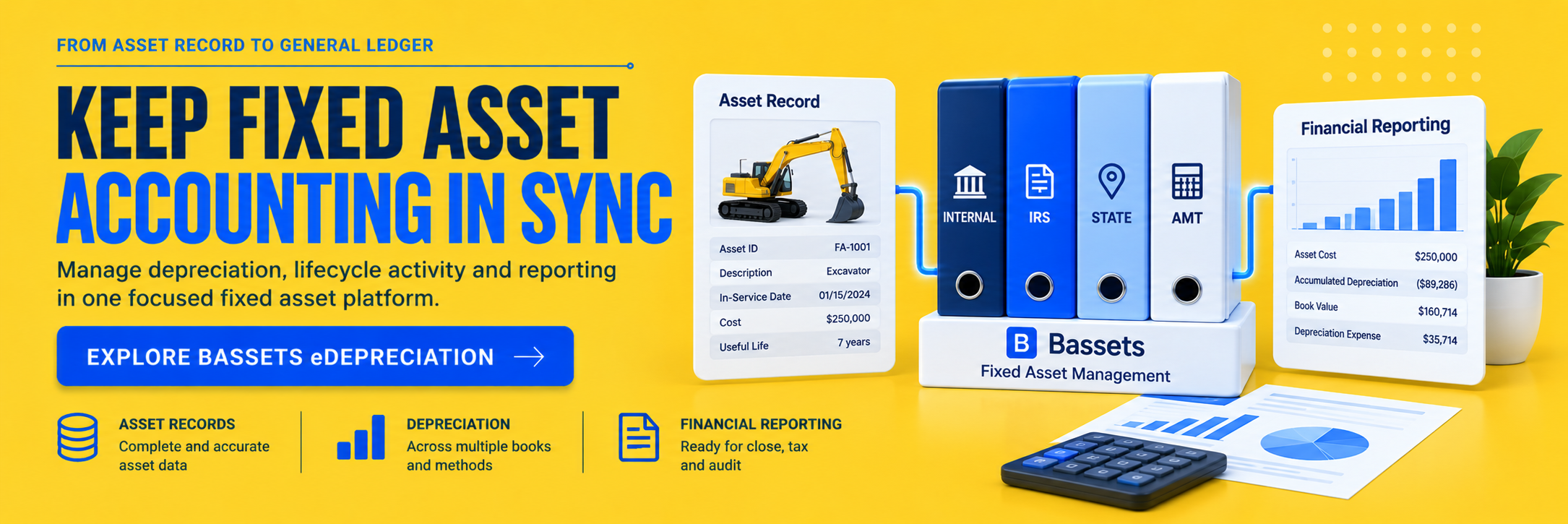
Bassets eDepreciation is a dedicated fixed asset and depreciation platform. Current Bassets product information describes flexible conversion from spreadsheets and other fixed asset software, more than 20 standard reports with SQL report-writing support, depreciation schedule validation, GL data export and integration, historical reporting, future projections, and complete or partial transfers and disposals.
Those capabilities are designed around the same accounting lifecycle covered in this guide: establishing governed asset records, calculating depreciation, processing changes, producing finance reports, and moving fixed asset data into general ledger workflows. Finance teams assessing fit should test the platform against their actual asset data, depreciation treatments, reports, transactions, and reconciliation requirements.
Fixed Asset Accounting FAQs
What is fixed asset accounting?
Fixed asset accounting is the process of recording and reporting long-term assets from initial recognition through depreciation, changes, reconciliation, and disposal. It helps finance maintain the detailed records needed to support financial reporting, tax calculations, close procedures, and audit review.
What is considered a fixed asset in accounting?
A fixed asset is generally a long-term resource used in operations rather than held for resale. Buildings, machinery, vehicles, furniture, fixtures, and computer equipment are common examples, although classification depends on the facts and the organization’s accounting policies.
How do you record a fixed asset in accounting?
A qualifying asset is recorded at the amount determined under the organization’s capitalization policy, with relevant dates, classification, useful life, depreciation method, and other required data captured in the fixed asset record. Depreciation and later asset transactions are then recorded over the asset’s lifecycle.
What is the journal entry for a fixed asset?
For a simple cash purchase, the initial entry generally debits the appropriate fixed asset account and credits cash. Subsequent depreciation generally debits depreciation expense and credits accumulated depreciation. More complex acquisitions and disposals require entries based on the specific transaction and applicable accounting policy.
How do you reconcile fixed assets to the general ledger?
Compare the detailed fixed asset records with the related GL balances and activity, including asset cost, additions, accumulated depreciation, depreciation expense, transfers, adjustments, and disposals. Investigate differences, document corrections, and confirm that the asset records and GL reflect the same underlying transactions.